Prepare your body, your mind and your iman for birth.
The birth preparation guide written for the Muslim mother. Eight parts, from what your body already knows to the forty days after, bringing together evidence-based guidance, faith and du'as to accompany you along the way.
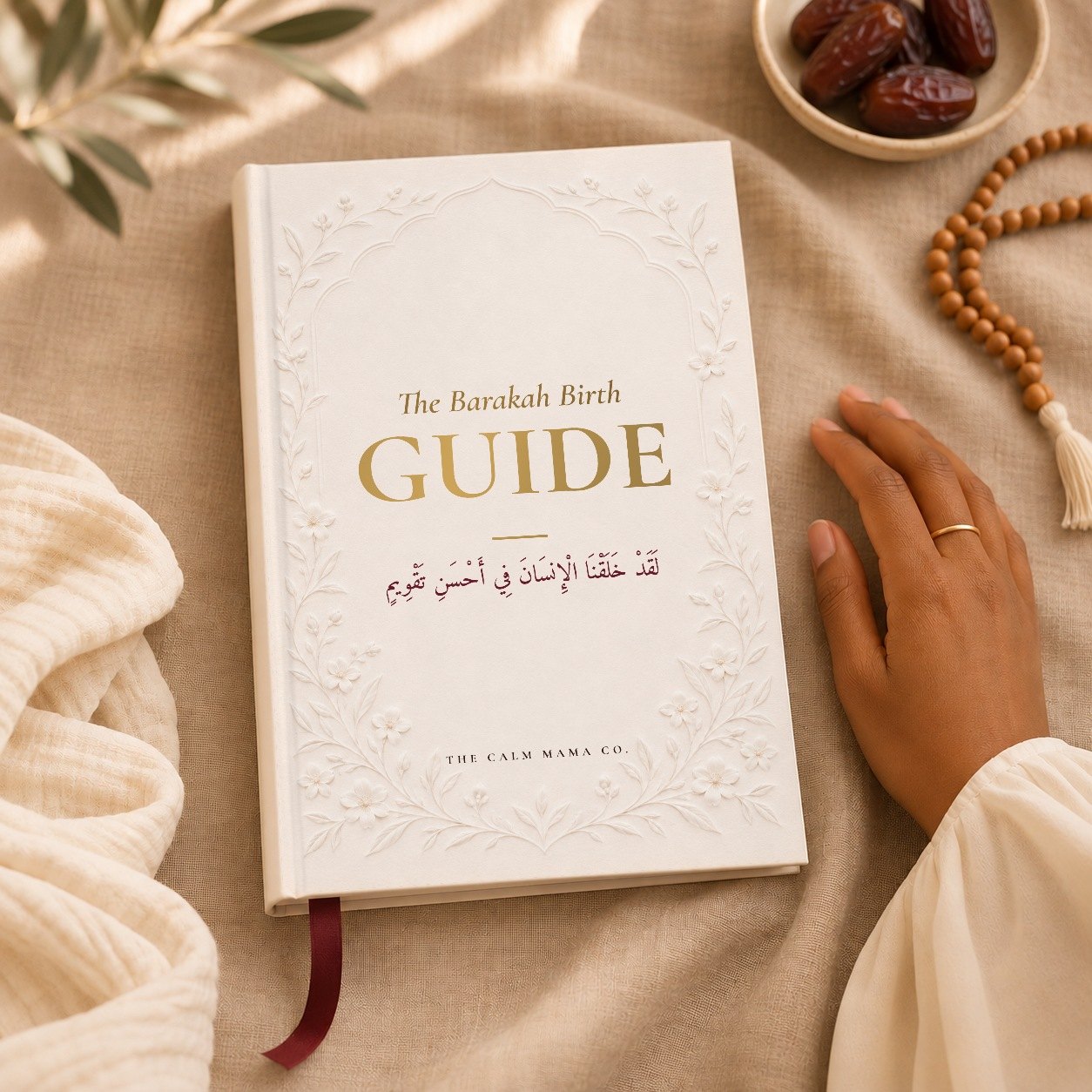
Most birth preparation stops at the body.
Fear tightens the body. Tension makes every surge harder, and the harder it feels, the more afraid you become. Breaking that cycle means reaching the anxious mind and the believing heart as well. This guide begins where you begin: with tawakkul, with dhikr, with du'a, and with a body Allah designed to give birth.
لَقَدْ خَلَقْنَا الْإِنسَانَ فِي أَحْسَنِ تَقْوِيمٍ
Laqad khalaqnal-insana fi ahsani taqwim
'We have certainly created man in the best of stature.'
Qur'an 95:4
Four pillars. One preparation.
Islamic Teachings
Du'a, prophetic guidance and Qur'anic wisdom, woven into the structure of your preparation rather than added on top of it.
Hypnobirthing
Breathing, relaxation and visualisation that break the fear, tension and pain cycle before it takes hold.
NLP Principles
Mindset work that loosens old fears and reframes what you have been told to expect from birth.
Birth Physiology
How your body gives birth, explained clearly, and how it responds to preparation and to faith.
Not adapted for you. Written for you.
General hypnobirthing teaches the body. This guide prepares the whole of you.
Eight parts, from your first practice to the forty days after.
47 pages, ending with a printable Labour Card for your birth bag. Written to be read through once and then returned to, part by part, from the second trimester.
- PART IBefore You BeginA word to you, how to use the guide, and a glossary of the Arabic terms within it.
- PART IIWhat Your Body Already KnowsOxytocin, the fear, tension and pain cycle, and why the words you use matter.
- PART IIIThe Faith That Makes It PossibleTawakkul, dhikr as a physical tool, Maryam (AS), and the du'as of labour.
- PART IVThe PracticesThree breathing techniques, three visualisations, anchoring and affirmations.
- PART VThe Baby's JourneyThe soul at 120 days, du'as through pregnancy, and connecting before birth.
- PART VIYour Birth SpaceThe five senses, hospital preparation, birth preferences, your birth partner's role, and a map of labour, stage by stage.
- PART VIIWhen the Plan ChangesInduction, pain relief, caesarean birth, and what to do if birth was hard.
- PART VIIIThe Fourth TrimesterThe first hour, the newborn sunnahs, warmth and nourishment, nifas, and returning to salah.
See the pages before you begin.
وَهُزِّي إِلَيْكِ بِجِذْعِ النَّخْلَةِ تُسَاقِطْ عَلَيْكِ رُطَبًا جَنِيًّا
'And shake toward you the trunk of the palm tree. It will drop upon you ripe, fresh dates.'
SURAH MARYAM, 19:25
This guide recommends eating dates in the final weeks of pregnancy and during early labour. But the word 'recommends' understates what the evidence actually shows.
Print this page. Put it in your birth bag. Give a copy to your birth partner.
THE THREE BREATHS- Calm breathing. In for four, hold for two, out for eight.
- Surge breathing. A long slow breath out through each surge.
- Birth breathing. Breathe down, soft jaw, let the exhale lead.
- Early labour. Rest, eat, drink, dim the lights.
- Active labour. Upright and forward. Change position.
- Transition. 'I can't do this' means you are nearly there.
اللَّهُمَّ لَا سَهْلَ إِلَّا مَا جَعَلْتَهُ سَهْلًا
Allahumma la sahla illa ma ja'altahu sahla.
It is a sunnah, held by most scholars, to recite the adhan softly in the baby's right ear, so the first words they hear in this world are the words of Allah's greatness.
In Arabic, adhan and udhun, the ear, come from the same root. The call to prayer is, at its heart, something given to the ear.
The word comes from al-hanak, the palate. Tahnik is softening a tiny piece of date and rubbing a little inside the baby's mouth. Then you make du'a for them.
Induced, with an epidural, or by caesarean. This still belongs to you.
This is not preparation for one perfect outcome. The breath, the dhikr and the calm you practise come with you into any room, whichever way your baby arrives. Part VII prepares you for the moment the plan changes, so that it does not take your peace with it.
'I wrote the guide I wished existed. One that recognises that a Muslim woman does not leave her faith at the door when she enters the birthing room.'
Hoda, Founder
Qualified antenatal educator, published researcher and poet.
From women who prepared this way.
'I had imagined a natural birth. When the doctor told me I needed an emergency C-section, I felt fear and something close to grief. Then I remembered: Allah chose this path for me. As I lay on the operating table, I recited Bismillah and held onto HasbunAllahu wa ni'mal Wakeel. When I heard my baby's first cry, everything else fell away. She arrived exactly as Allah had written it. I would not change a moment.'
'I was devastated when I needed an induction at 42 weeks. I had prepared for something different. But I used everything I had learned, the breathing, the visualisation, the constant dhikr between surges. Even with the drip, even with the monitoring, I felt present and calm. My husband recited Quran softly throughout. When I held my son, I understood: all births, however they arrive, are miracles. Every path to this moment is the right one.'
'I was terrified of birth until I read this. Not because it made it disappear, but because it made it meaningful. I understood what my body was doing and why. That shift changed how I prepared, and how I felt throughout.'
The Barakah Birth Guide
The complete eight-part preparation, from what your body already knows to the forty days after. Du'as in Arabic, transliteration and translation. An instant PDF to read on any device or print at home.
£28 Begin with the GuideThe Barakah Birth Toolkit
The Guide with the 56 Barakah Affirmation Cards, 21 Birth Partner Cards, 8 Reflection Cards, the Barakah Birth Journal, the Calm Birth Planner and A Letter to the Father. Everything from the first trimester to the fourth.
Before you begin.
When should I start?
Ideally from the second trimester, so the breathing and anchoring have time to become second nature. It is never too late to begin.
Is it for a first baby only?
No. Many mothers come to it after a hard first birth, wanting the next to feel different.
How do I receive it?
Your PDF is emailed the moment you buy. Read it on your phone, tablet or laptop, or print it at home.
Can I see inside before I buy?
Yes. The pages above show how the Guide looks and reads, and A Letter to the Mother is free to read on the site.
Birth belongs to you.
Begin today, and arrive at birth prepared in body, mind and soul.
This guide is educational. It supports, and does not replace, the care of your midwife or doctor.